The Lab
Ausculta
Instant audio diagnosis for machines and devices.
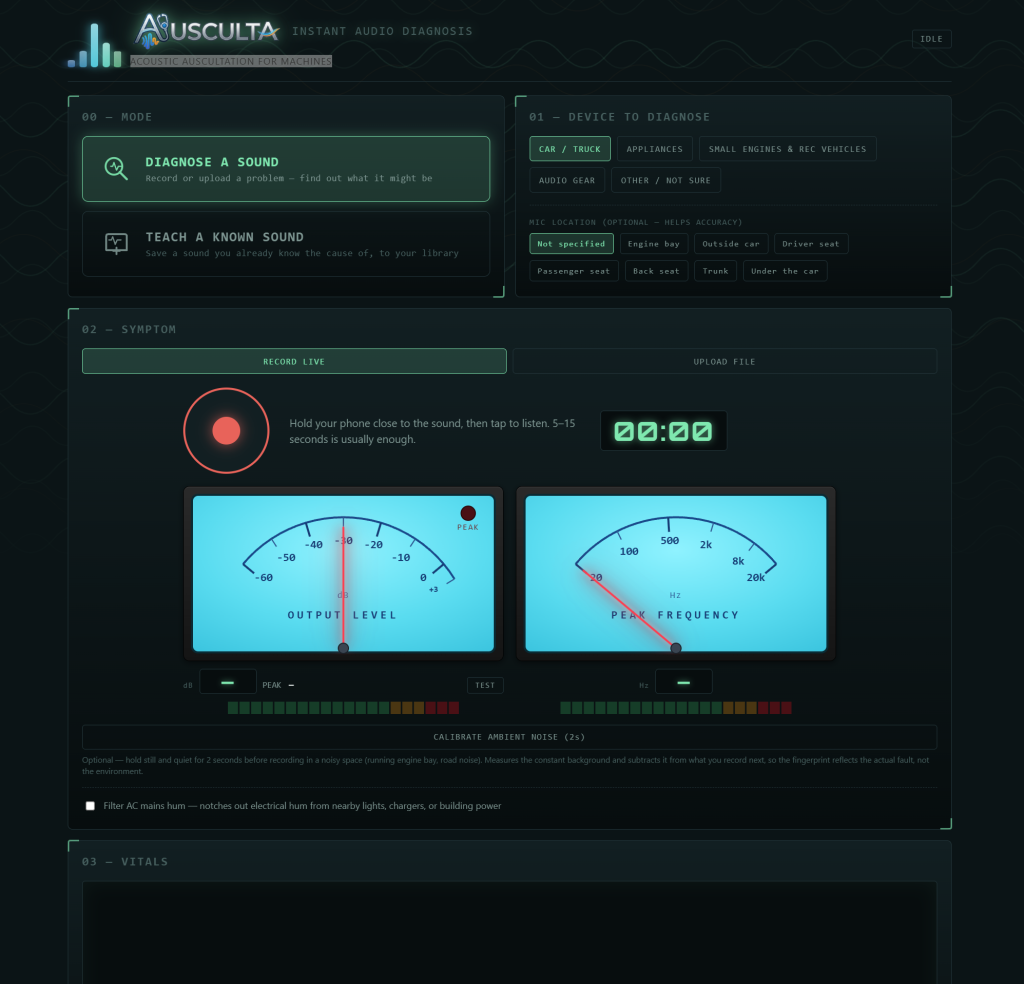
Record or upload the sound a car, appliance, small engine or piece of audio gear is making. Ausculta compares it with known fault signatures and suggests what might be wrong, or learns the sound as a new one.

How it works
Listen, fingerprint, match.
- 01
Record or upload
Capture the sound with your microphone or load an audio file. Live VU meters and a spectrogram show what’s being heard.
- 02
Fingerprint the sound
The recording is reduced to a compact acoustic fingerprint that describes its tone, texture and rhythm.
- 03
Match or teach
The fingerprint is compared with a library of known faults, with likely causes, severity and next steps. New sounds can be taught to the library.
Cars & trucks
Appliances
Small engines
Audio gear
dimensions in every sound fingerprint
example sounds in the library so far
servers: everything runs in your browser
self-contained HTML file, with a mobile app planned
Under the hood
The technical details.
A single client-side app of about 4,000 lines, built on the Web Audio API with no backend.
Sound fingerprint
- 38-dimension vector: 20 log-spaced frequency bands plus 18 scalar features
- Features include spectral centroid, flatness, crest factor, kurtosis, attack and decay time, and centroid permutation entropy
- Vectors are L2-normalized at match time
Matching
- k=1 nearest-neighbor cosine similarity, which beat k=3 in leave-one-out testing
- Heuristic scoring per entry: pattern type, severity, likely causes and recommended actions
- Custom labels that match a built-in entry inherit its heuristics
Clean signal
- Speech and turn-signal rejection
- Startup-transient rejection and noise-floor calibration
- Optional mains hum filter (60/120 Hz or 50/100 Hz)
- Clipping and low-gain warnings
Storage & privacy
- Only fingerprints are stored, never the audio itself
- Saved in the browser, with auto-save to disk on Chrome and Edge
- The library loads from a JSON file served over HTTP
Interface
- Dual analog VU meters and LED bargraphs
- Live, DPI-aware spectrogram
- Guided batch-teach flow for adding new sounds
Accuracy & roadmap
- DTW, SVM, Random Forest and Mahalanobis distance were tested; none clearly beat the baseline
- The limit is data: most labels have only one or two examples
- Accuracy improves as more examples are taught, and a mobile app is planned
Help Ausculta learn.
Try the test build on a machine you know well. Every new example makes the diagnosis more accurate, and feedback is always welcome.